
AI is often sold as a shortcut through complexity — a way to speed things up, improve coordination, and eliminate friction from modern work. But inside real teams, especially where people are dispersed, the reverse happens. Workflows don't fail because the AI is weak. They fail because the way teams actually work doesn't match the assumptions baked into most AI tools.
This disconnect is getting harder to ignore. AI adoption is everywhere, but productivity gains aren't. Despite record investment and constant usage, most teams still struggle to show real improvement in how work actually moves forward.
Research from the Stanford Institute for Human-Centered AI points to the same pattern: AI is now embedded across day-to-day operations, but outcomes remain uneven and difficult to pin down. The issue isn't model capability. It's that most AI is being dropped into workflows that were never designed to support it.
The uncomfortable truth is simple. AI only works when teams already know how to work asynchronously. Without clear delegation, shared context, and async-first habits, AI doesn't speed things up — it adds friction.
AI creates leverage only when it adapts to how teams actually communicate, wait, and hand work off. The moment it assumes everyone is available, responsive, and aligned, the system starts to break.
Key Takeaways
- AI workflows break most often in teams that still rely on real-time coordination.
- Async isn't a nice-to-have for AI. Without it, automation falls apart quickly.
- Most failures come down to missing context, unclear ownership, or handoffs that were never defined.
- Bigger models don't fix broken workflows. Systems that adapt to how teams work do.
- AI works best when it supports collaboration, not when it tries to replace it.
The hidden dependency no one talks about: async culture
Most AI tools are built for a version of work that no longer exists. One where people respond instantly, information is always complete, and tasks move forward in neat, predictable steps.
That assumption breaks the moment teams become distributed.
Research into global teams from Harvard Business School shows how fragile coordination becomes once work spans time zones. Even small scheduling gaps reduce real-time communication and add friction. As teams spread across regions, async work stops being a preference and becomes the default — whether teams are ready for it or not.
In real async environments, progress depends on people being offline, information arriving late, and decisions stretching across hours or days. Context lives across documents, messages, and tools. None of this is unusual. It's normal.
Without strong async habits, AI runs into dead ends fast. It waits for information that doesn't exist yet, asks the wrong people at the wrong time, or pushes work forward before the team is actually ready.
What gets labelled as "AI failure" is usually something simpler: a mismatch between synchronous expectations and asynchronous reality. The tool isn't broken. The assumptions behind it are.
Why synchronous habits break AI workflows
Many teams describe themselves as async, but still behave as if everyone is always available. Tasks get delegated verbally in meetings. Decisions live in someone's head. Context only shows up once someone asks for it.
The cost of this fragmentation is easy to underestimate. Work on modern teamwork from Atlassian's State of Teams research shows that knowledge workers spend a significant amount of time simply searching for information that already exists somewhere inside the organisation.
When context is spread across conversations, documents, inboxes, and individual memory, both humans and AI are forced to guess. Over time, those guesses compound. Work slows down. Mistakes creep in. And workflows quietly degrade long before automation ever has a chance to help.
In this setup, progress depends on quick clarifications and real-time back-and-forth.
AI struggles here because it can't infer what was never written down. When ownership is vague, or critical information sits with a single person, automation becomes fragile. The moment that person is unavailable — in another time zone, in meetings, or simply offline — the workflow either stalls completely or moves forward with the wrong assumptions.
This is where frustration starts. Teams blame the AI for being unreliable, when in reality the tool is exposing communication gaps that existed long before automation entered the picture.
The collaboration gap: where AI actually fails
This gap between activity and impact is now visible across enterprise AI adoption. Usage continues to rise, yet measurable returns remain rare. Many organisations talk about AI as "strategic", while still struggling to point to clear productivity outcomes.
Commentary drawing on research from the MIT Media Lab highlights this tension. Deployment is accelerating faster than real-world results. The issue isn't intelligence. It's that collaboration and workflow design haven't caught up.
There's a persistent belief that AI fails because it isn't smart enough. In practice, most failures happen for a simpler reason: collaboration is underspecified.
AI depends on clear inputs, explicit delegation, shared definitions of what "done" actually means, and stable async rhythms. When those foundations are missing, the system doesn't know what to wait for, who to ask, or when it's safe to move forward. It keeps querying missing information, retries actions at the wrong moment, or generates output that creates even more work downstream.
That's why AI so often adds work instead of removing it. Humans step in to review, correct, and re-coordinate what the system couldn't infer on its own. The workload doesn't disappear. It just shifts.
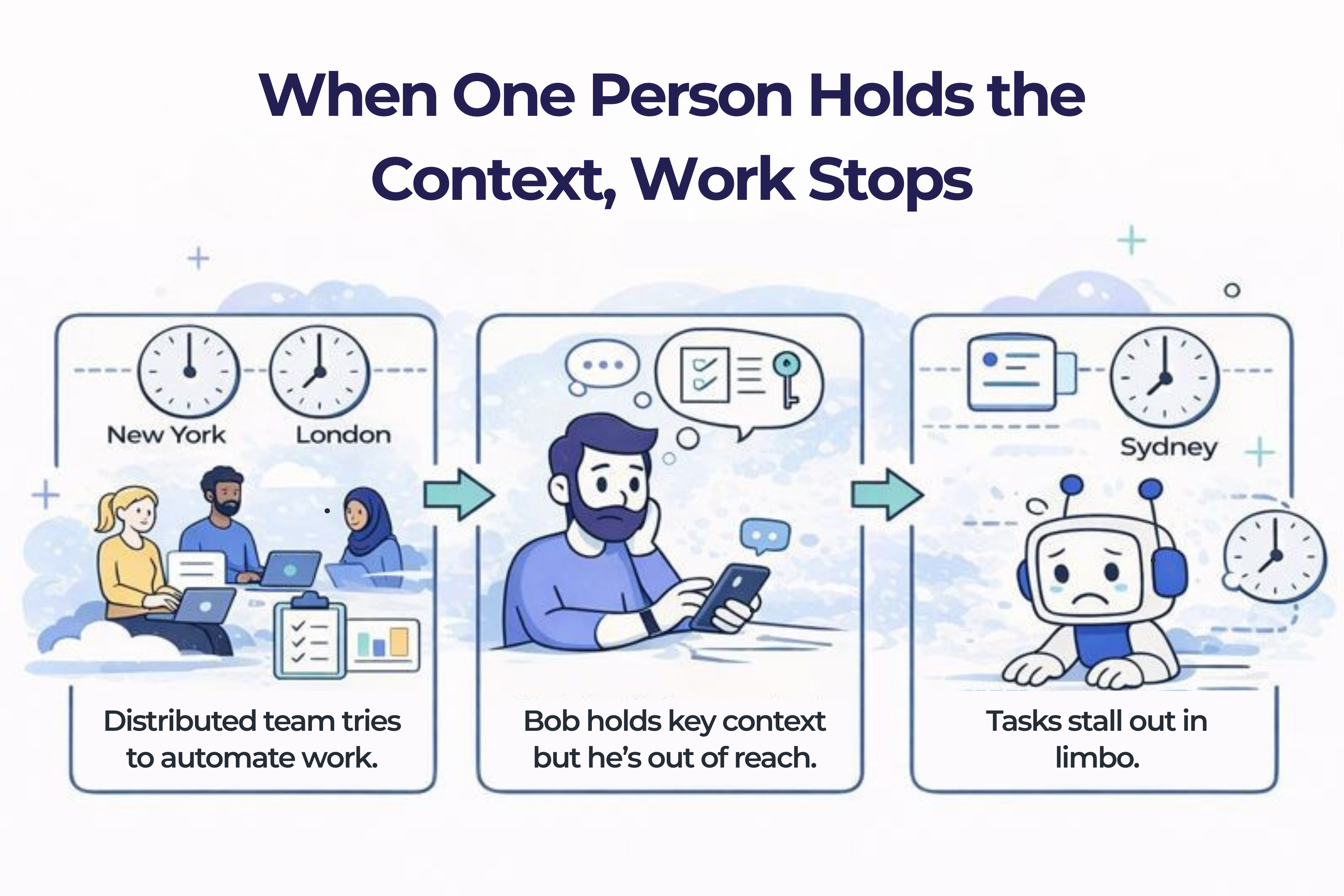
When One Person Holds the Context, Work Stops
We often see this play out as the "Bob bottleneck" — where one person becomes the blocker for the entire workflow.
Bob holds key context. He works in a different time zone. He checks messages a couple of times a day. The workflow depends on his input — but the system has no idea when that input will arrive.
Most tools handle this badly. They keep pushing tasks forward without the missing information, fail silently when something breaks, or force users to rebuild the workflow once Bob finally responds.
The problem isn't Bob. It's that the system doesn't recognise absence as a valid state.
Adaptive workflows treat missing context as expected, not exceptional. The workflow pauses instead of collapsing. Actions retry at the right moment. Momentum is preserved without constant human intervention.
Where AI actually fits in team collaboration
AI isn't a replacement for collaboration. It's a participant in it.
When it works well, AI helps teams hold shared context, surface the right information at the right time, and reduce unnecessary follow-ups. It respects async boundaries instead of constantly pushing work forward.
But this only works when workflows reflect reality. People are busy. Information arrives late. Work rarely moves in straight lines.
The most common mistake organisations make is dropping AI into broken collaboration patterns and expecting the tool to fix them. AI doesn't repair weak communication. It amplifies it. Only when collaboration is designed with async reality in mind does AI start to deliver real value.
Practical steps teams can take right now
If teams want AI to genuinely support async work, the starting point isn't better prompts or bigger models. It's better habits.
Clear delegation matters more than most teams realise. Tasks need explicit ownership, clear inputs, and a shared understanding of what "done" actually means. If a human would need a follow-up meeting to understand the task, an AI system will struggle even more.
Missing context should be treated as normal, not exceptional. Good workflows pause, wait, and resume without collapsing. Absence isn't a failure state — it's part of how distributed work functions.
Writing things down clearly, once, also matters more than most automation tweaks. AI amplifies whatever structure already exists. When documentation is vague or scattered, the output reflects that.
It also helps to map async dependencies. Knowing where work depends on time zones, availability, or specific people makes it easier to design workflows that adapt instead of breaking under pressure.
And finally, teams need to stop expecting AI to fix culture. Tools don't create async habits. People do. AI only becomes effective once those habits are already in place.
The real takeaway
AI doesn't break workflows. Reality does. Distributed work, async communication, and human unpredictability aren't problems to be eliminated. They're constraints to be designed around.
AI only creates value when it's built to operate inside those constraints — not when it pretends they don't exist.
The future of productive AI isn't about more output, faster generation, or bigger models. It's about systems that understand collaboration, respect timing, and adapt to how teams actually work. That's where workflows stop breaking. That's where AI starts helping.