
At Alknoma, we weren't trying to reinvent work. We were mostly just trying to survive it.
We work in Tech ourselves, and we learned that the promise of a flexible, online workplace with coworkers all over the world doesn't always create conditions for good work. It sounds great in theory. You have flexible hours to get work done. Digital tools recreate the office. And handoffs across time zones should work like a well-oiled machine. You complete your workday. The next time zone finishes their part while you sleep. Everyone reconnects during the brief schedule overlap.
There's just one problem: the coordination that eats up the day.
This process depends on perfect conditions. What we actually experience is that pattern. You know the one… That pattern of constantly doubling back. People searching for clarity, the most recent document, the right person to loop in. All the follow ups, last-minute requests, rework, meetings that go nowhere, and the list goes on. Status updates are tracked, but the work itself stubbornly refuses to move forward. Employees are spending more time coordinating work than executing it.
AI tools like ChatGPT, Microsoft Copilot, and Google Gemini were supposed to help. They generate content, but they also increase expected workloads. A human is still required to prompt and align every piece of AI content. Progress stalls every time someone logs off, breaking down asynchronous work cultures.
If this sounds like your team… We've been there.
The reality is AI will not ease workloads until businesses create AI that works for humans, not the other way around. Alknoma is changing this with Ayven, real AI automation built for team operations. Ayven works alongside you in Slack and Teams and connects with your digital tools to gain context of your workflows. Using your company's intelligence, it handles multi-step coordination and ships work for you, no chasing required.
The problem with the modern state of work
Asynchronous work—where employees work on their own schedules, without relying on real-time interaction—is heavily relied upon today. Nearly one-third of meetings are across multiple time zones, a 35% increase since 2021. With teams spread across time zones, async work is essential in theory. In practice, it's breaking down. We see three factors causing this.

Async cultures stop work in its tracks
Projects estimated to take days turn into weeks. Assignment instructions are unclear, and days are filled with micromanagement and random "quick questions" through messaging. Microsoft 365 data shows that employees are interrupted by a meeting, email, or notification every two minutes on average. Working across time zones makes this worse. Context gets lost in handoffs, causing work to stop.
This isn't a small tradeoff. Many employees spend their days consumed by other people's agendas, cutting into the finite 4-hour focus window needed for meaningful work. Instead, they're forced to push real execution to the end of the day, when their brain power is gone. Then the real work begins, and teams are immediately met with blockers. Emails with 20+ recipients increased by 7% this year alone, signaling more complex projects and uncertainty around ownership in teams.
Employees are trapped in Agile rituals
To regain control, companies add process. They introduce rigid workflows like process documentation, assignment trackers, and standups. Work time is spent inside Agile rituals instead of actual delivery.
According to Microsoft's 2025 Work Trend Index, 53% of leaders say that productivity must increase. At the same time, 80% of the global workforce, leaders included, report that they don't have enough time to complete their work. The math isn't adding up. No amount of process can close the gap when business demands are outpacing human capacity.
AI tools are not helping async teams
Let's talk about it. Tools like ChatGPT and Microsoft Copilot are hurting, not helping async teams. They appear like productivity boosters. The reality is quite different. According to The Upwork Research Institute, 81% of C-suite leaders say they've increased employee workloads because of AI. Meanwhile, 47% of employees say they don't know how to achieve the AI productivity that their bosses expect.
While AI speeds up output, it also generates "workslop." The low-quality, passable work that ends up creating more work in the long run. All of this work is highly dependent on people.
AI gets you to 90% done and then it requires the same amount of time it would have otherwise taken to clean it up and achieve the last 10%.
So this is where we landed
The result is messy work that's hard to keep track of. Workflows refuse to close, boundaries erode, and work never truly ends in what's being called the Infinite Workday.
What's needed isn't AI layered on top of this broken system to generate even more work. It's a new class of intelligent AI automation built to deliver real outcomes. Already, 81% of business leaders from a survey sample of 31,000 workers say they expect to moderately or extensively integrate an AI agent within their company in the next 12-18 months.
Meet Your New Conversational, Strategic Partner: Ayven
AI automation for async teams who are tired of pretending it's working
Most work stops the moment a person signs off. And the work culture isn't really asynchronous if it depends on everyone being online at the same time. Ayven is built to create a digital work environment that doesn't bottleneck. Unlike other AI tools, it doesn't need prompting from a human. It works autonomously alongside your teams to move work forward. Think Claude Code, but for team operations.
Ayven lives in Slack or Teams and integrates with your digital tools. Once granted access, it is continuously checking connected systems and documents to understand context, progress workflows, and initiate action. Ayven is activated by missing information or key decision points, where a live chat will launch to gather the right context and execute the next step.
Its memory updates conversationally and continuously, it doesn't reset, to understand both immediate tasks and long-term projects. This context allows Ayven to:
- Interpret each employee's intent
- Spot their blockers
- Prompt the right people for input
- Research and monitor to answer strategic questions
- Complete work with the same context you'd use
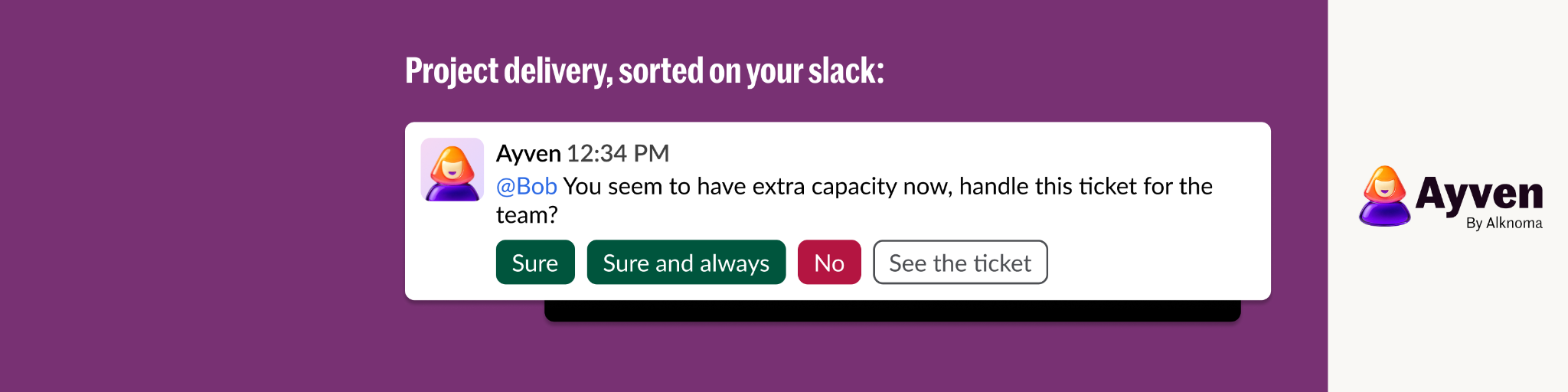
Ayven uses a human-in-the-loop approach to gate sensitive actions that require work from colleagues. The automation will simply request your approval before proceeding to prevent unintended actions. When Ayven needs your input, it batches requests so you're not spammed with notifications. Once it receives its answer, it takes action to keep work moving after you've logged off, so you wake up to progress.
Eliminate the time zone tax adding weeks to your project timelines
Instead of forcing handoffs when the work is not quite ready and trying to catch colleagues before they log off, Ayven bridges the gap between you and your team members across time zones.
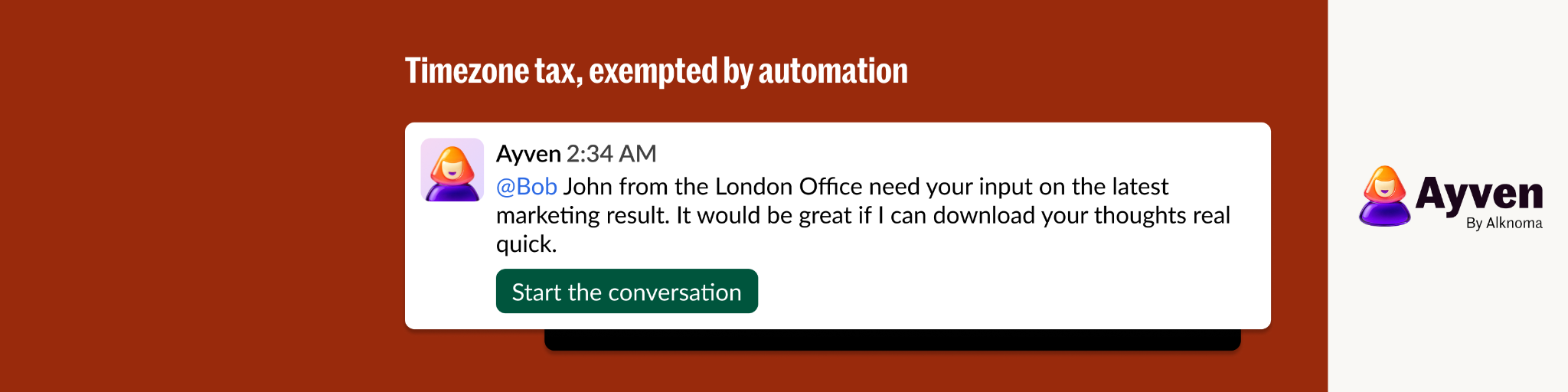
Onboarding is simple. Ayven walks each employee through a short intro flow to learn their role, availability preferences, and working hours. The automation connects the dots across these relationships and retains this information as flexible constraints. From there, Ayven requests information when it's needed. Team members respond in their own time zone. Ayven resumes execution when enough context is available, eliminating the time zone tax.
If someone is unresponsive, Ayven doesn't wait indefinitely. It reroutes requests to alternative stakeholders when appropriate and surfaces blockers back to users with clear context. If a workflow hits too many dead ends, Ayven pauses the action and notifies you to investigate.
Execute work that's superior to other AI tools
Right now, most employees aren't using AI to reduce their workload. The nature of their work has just shifted. They're prompting and editing AI-generated outputs that take just as long as starting from scratch. Ayven produces finished AI-executed work with all the nuance from your tech stack. The associate's research. Your colleague's notes. That back-and-forth with your manager. All of the activity that so often disappears in one-on-one chats or siloed teams.
It uses your documents to complete strategic tasks like competitive research, customer analysis, and market synthesis. Its search queries pull up the correct information, flag if something is outdated, and fill in the gaps for fragmented notes, turning scattered knowledge into superior work. The result is AI outputs that close work loops and a workday that actually ends, so progress doesn't depend on you bringing work home with you.
Integrations
See Ayven in action by integrating with your digital workplace. It collects context from one system, acts in another, and reports back to you asynchronously.
Standard Plan (included):
- Slack
- Microsoft Teams
- Google Drive
- Notion
- Jira
- Youtrack
More integrations to come in enterprise knowledge and documentation bases.
Enterprise Plan:
For SaaS enterprises with complex needs, we offer custom integrations with your existing processes and applications. This is the difference between isolated improvements and unlocking hyperproductivity across the full digital ecosystem to achieve enterprise transformation.
Data security and governance: Drive value, not risk
Alknoma prioritizes high standards of data privacy and security. Users simply integrate their desired technology applications and all their proprietary data remains their own, in their own systems.
What's unique about Ayven's data handling is that almost no client data is stored in Alknoma servers. No documents, raw conversation text, meeting transcripts, or chat logs are recorded. When an action requires user approval, the operation state briefly persists to resume the workflow. Upon completion of the workflow via approval, rejection, or resolution, the operational data automatically clears.
Embeddings consisting of gibberish numerical vectors, and containing no raw text and no readable content, are used for semantic search. Collection access settings can be configured to enable broader cross-content semantic lookup without duplicating or storing raw data. All embeddings can be removed.
Alknoma also provides a secondary Ayven interface for leaders who want to know what actions the automation is taking and the reasoning behind them, with optional levers to adjust behavior. This format provides oversight and control without burdening your team with yet another dashboard or tool that competes for their attention.
The benefits of scaling AI intelligence with automation
AI agents are already delivering major productivity gains. In PwC's 2025 AI Agent Survey, 66% of senior executives who have adopted an agent say they are already seeing increased productivity. Looking ahead, 71% agree that AI is advancing so quickly that agents will rival the capabilities of a human within two years.
Seeing measurable value typically depends on what percentage of employees are leveraging the automation to help accomplish their daily work. Within this same study, 68% reported that half or fewer of their employees work with the agents. Alknoma unlocks this next frontier of AI productivity by giving all employees access to AI automation that helps them work optimally.
With Ayven, enterprises are able to:
- Prevent work from becoming siloed across teams, time zones, and projects
- Remove a large class of manual work coordination
- Scale AI intelligence to meet their capacity constraints
- Reclaim time to execute human-led creative and strategic work
- Accelerate project delivery
Among 844 companies with mature AI deployments, current agent use, and the belief that automation is important to their ROI:
- 71% say their company is thriving, compared to 39% globally
- 55% say that they have capacity for more work, compared to 25% globally
A lighter way to work
If you work in one of these flexible, online-first work environments, it's worth considering.
Does your async culture really scale across all time zones and teams? Or does it only work when everyone is quietly online at the same time?
The most successful companies in the future won't be the ones asking their employees to work nonstop. They'll be the ones where work flows freely with automation that supports human agency, creativity, and productivity. That's the kind of work we're trying to make possible at Alknoma.