
A lot of AI stories talk about productivity gains and massive efficiency improvements. In most examples, the "success" of an AI system comes down to two things: how much time it saves and how much money it cuts. But when you actually look inside real teams, almost none of that holds up. Teams aren't failing because they don't have the latest model — they're failing because the workflows break the moment the AI no longer understands what's happening inside the team.
AI only creates real productivity when it adapts to the messy, shifting realities of how teams actually work — not the idealised workflows most tools assume.
Key Takeaways
- AI productivity often breaks down in real teams because most tools ignore context, timing, and human behaviour.
- The AI paradox is real: more output usually leads to more review work, not more progress.
- Adaptive, context-aware workflows are essential for AI to deliver meaningful time savings.
- Real productivity happens when AI adjusts to the team — not when teams are forced to adjust to rigid tools.
The real productivity story no one talks about
AI companies love talking about productivity — "save 20% of your time," "double your output," "do in minutes what used to take hours." It sounds impressive, but there's a big gap between what teams are being promised and what actually happens in practice.
A recent MIT study, State of AI in Business 2025, shows that 95% of enterprise GenAI pilots fail, and 78% of companies calling AI 'strategic' can't show any measurable ROI. That tells you everything: most AI tools don't save the time they claim to, and the moments you think you're getting more efficient are often the moments you're actually losing time.
Where AI productivity claims fall apart
When you look closely, the numbers start to fall apart — mainly because they ignore the real complexity of day-to-day work. Most AI tools overpromise on productivity because they measure the wrong thing. They focus on output — how much gets produced, instead of the work that actually matters: the reviewing, the follow-ups, the waiting, the coordination, and all the messy human context that determines whether anything moves forward. That's why people often feel more productive without being any closer to the outcome they need.
A big part of the industry narrative is built on feel-good claims like "you'll feel more productive," "you'll produce more content," or "you'll generate ideas faster." But feeling productive doesn't mean you've saved any time. The real difference is simple: feeling productive means generating more output; being productive means the right work happened faster, with fewer blockers, and without creating downstream issues. Most AI marketing focuses on the former — real teams care about the latter.
The AI productivity paradox: More output = more work to review
AI creates a productivity paradox: it makes us feel faster and more fulfilled, yet often leaves us with more work. It's the part of technological change no one talks about — the messy, gradual, invisible side. Most AI tools generate more output, but they don't reduce the work that actually slows teams down. Ten drafts, multiple variations, endless options — someone still has to review, validate, and decide, and that "someone" is already stretched.
In practice, AI increases the volume of work while humans still own the quality, so the workload shifts instead of shrinking. Managers end up acting more like editors of AI-generated content than strategists or decision-makers. And when you add it all up, the amount of time actually saved is often close to zero.
Why AI workflows fail inside real teams
One of the most common real-world failures looks something like this: a team builds an automated workflow that relies on information from multiple people, and everything works fine until one person becomes the bottleneck.
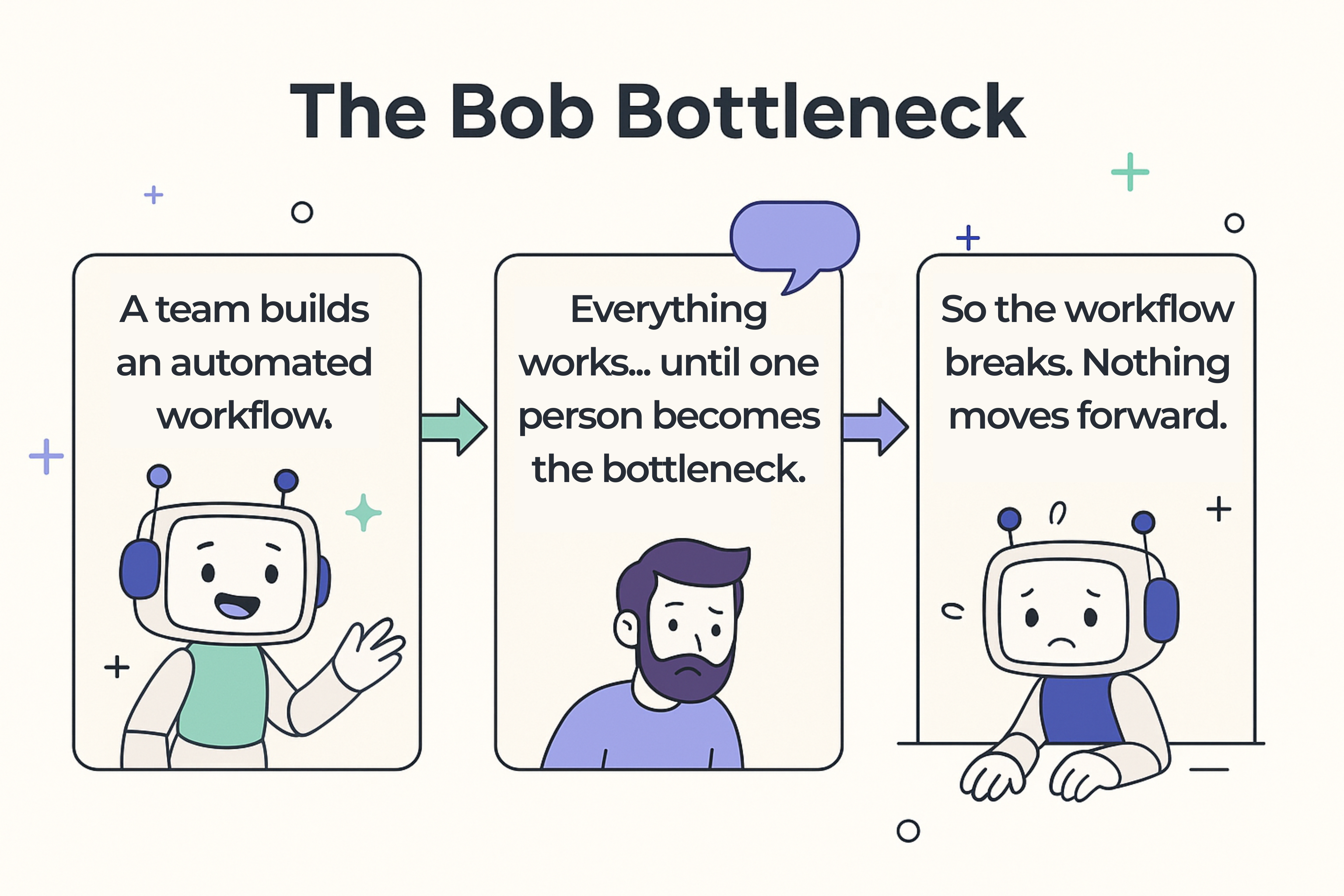
The "Bob bottleneck" — a single unavailable person stopping an entire AI workflow.
Let's call him Bob. Bob holds a key piece of information, but he's slow to reply — maybe he's in a different time zone, in a meeting, deep in focused work, or simply not available. The AI workflow still tries to fetch the data from Bob, but it doesn't exist yet, so the entire flow breaks. Nothing moves forward, no time is saved, and the frustration starts. AI only works when it has the right information at the right moment — the timing, the updates, the availability.
The second someone doesn't respond, or the data isn't there, or the workflow depends on someone like Bob being instantly accessible, the whole system collapses. This is the part most AI tools don't understand: real teams run on culture, timing, context, and human behaviour. And this is why so many AI time-saving promises fall apart in practice.
Context is the missing ingredient — and why adaptive workflows matter
Most AI tools treat workflows as if they're perfect, predictable systems — but real teams are messy. Context is constantly shifting: who's available, who has the missing information, who's become the bottleneck, what's outdated, what's blocked, and what needs to happen next. Typical AI tools don't track any of this. They operate in a vacuum, assuming that all information exists, everyone responds instantly, and every task follows a clean, linear path. But that's not how real teams work, and it's exactly where time is lost instead of gained. This is where adaptive workflows make the difference.
Typical AI tools run tasks instantly, but break the moment information is missing. They don't adjust based on team context, and they force users to rebuild flows manually whenever something changes. Adaptive agents work differently: they understand when key data isn't available yet, recognise when someone is busy or offline, retry actions at the right moment, and follow the actual rhythm of the team. They preserve the workflow instead of collapsing it.
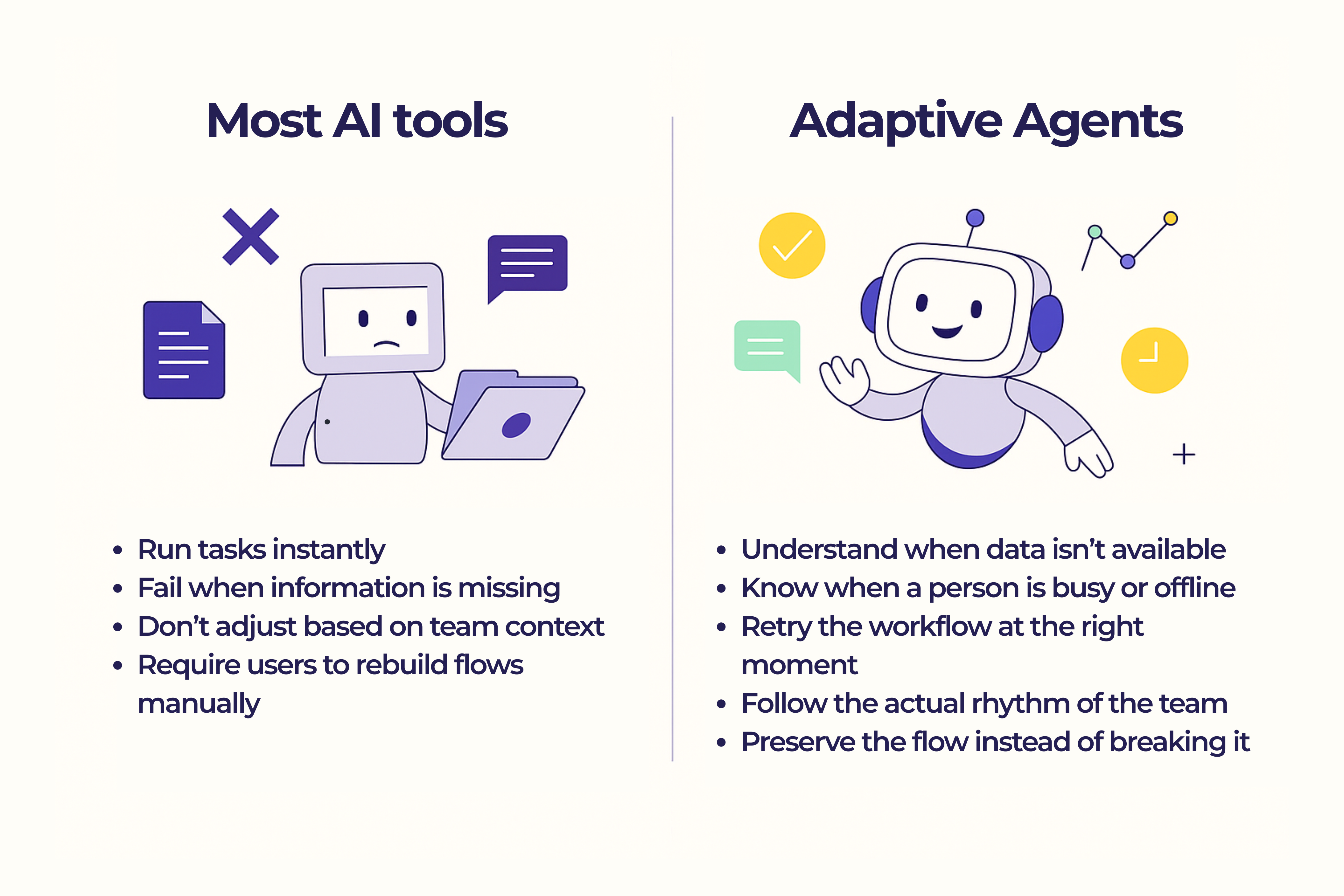
A comparison of AI tools that break without context and adaptive agents that keep workflows moving.
This is the real divide between automating outputs and automating outcomes. Meaningful productivity only happens when workflows don't break, people aren't forced to rebuild them, and the system adapts to the team — not the other way around.
There's also a deeper problem most teams never consider: sunk costs. When a static AI workflow breaks because the way a team operates has changed, everything built into that workflow becomes unusable. The time spent configuring steps, training the system, and handling exceptions must be repeated from scratch. In many organisations, this means teams end up losing more time maintaining brittle workflows than they ever hoped to save. It's one of the hidden costs of corporate AI systems that aren't designed to adapt.
Where AI actually saves time
For AI to genuinely save time, it must survive the realities of how teams work — the delays, the missing context, the blockers, and the constant changes that don't appear in a clean process diagram. The truth is, AI only creates real efficiency when it reduces the work people actually do: chasing information, reviewing low-quality output, rebuilding broken workflows, and waiting for someone who has the missing piece. Most tools don't touch those parts. They generate more output, not more progress.
A more realistic version of productivity starts with understanding where time is really lost. It's in the handovers, the follow-ups, the coordination, the things that depend on people rather than models. AI helps only when it adapts to those dynamics — when it knows someone is offline, when data doesn't exist yet, when the timing is wrong, and when the workflow needs to pause rather than break.
That's why adaptive, context-aware systems matter so much more than bigger models or faster generation speeds. They don't just automate tasks; they automate the conditions that allow work to move forward.
And this is the part the industry doesn't talk about:
AI won't replace the messy realities of teamwork. It won't erase the bottlenecks created by people. It won't magically deliver the productivity numbers in the marketing slides.
But when AI is built to understand how teams actually operate — their timing, their gaps, their constraints — it finally has a chance to deliver on the promise everyone keeps repeating. That's where meaningful time savings come from. That's where real productivity starts. And that's the direction the next generation of AI systems needs to move toward.
Practical Steps Teams Can Take Right Now
If you want AI to actually save time, there are a few practical steps teams can take right now:
- Map where time is really being lost.
Look closely at review cycles, handovers, missing information, and the moments where work stops because someone isn't available. These friction points matter far more than output volume.
- Stress-test your existing workflows for context gaps.
Pick one workflow and ask: What happens if the person with the missing piece of information isn't available? If everything breaks, you've identified the real failure mode — not the AI model, but the assumptions behind it.
- Identify who holds the key knowledge.
Most delays come from a small number of people — the "context holders." Understanding who they are and where the dependencies sit helps teams design workflows that don't fall apart when someone is busy, offline, or working differently that day.
- Design workflows that can pause and restart, not collapse.
Aim for processes that can wait, retry, or shift based on timing and availability. Even small shifts toward adaptability can save more time than trying to automate the "perfect" workflow.
These steps won't solve every problem, but they create a more realistic foundation — one where AI supports how teams actually work, instead of how a workflow diagram assumes they do.
About Alknoma
Alknoma focuses on the parts of work that are often overlooked — context, timing, and how teams actually operate. The platform uses AI to organise knowledge, surface relevant information, and support workflows in a way that reduces bottlenecks and helps teams move more effectively.